Art Appreciation Chapter 11 Vincent Van Gogh the Bedroom
Introduction
Prologue
Over the concluding ii decades, at that place has been an increasing interest in the human relationship between the art and the brain. The focus of this research spans from the investigation of how the brain reacts to art to the try to understand the biological underpinning of the artistic experience, with the ultimate aim of deriving more than general insights into other cognitive processes. Such an interest has coalesced into two independent areas with some caste of overlap, neuroesthetics and neuroscience of art. Specifically, neuroestethic experiments have sought to make up one's mind the neural underpinnings of esthetic experience, with research including but not being express to art. In dissimilarity, the neuroscience of art has instead focused on studying the mechanisms underlying human appointment with fine art, focusing not merely on esthetic experience only also on social, semantic, contextual, and evolutionary aspects—for a discussion and review see Pearce et al. (1).
Neuroesthetic studies have explored the neural correlates of human esthetic preference (2); for instance Ticini et al. (iii) investigated how congruent priming for brushstrokes positively affects esthetic sentence, Wang et al. (iv) explored the neural correlates of heed wandering while attending mural paintings, while Salimpoor and colleagues attended at the neuroanatomical and neurochemical bases of listening to music (v, 6), to cite a few.
The neuroscience of art has brought forward investigations in the attractiveness of art for humans (7, 8), likewise equally theories as to what the biological office of art might exist, for instance by arguing that art is a way to brandish talent and genetic quality (9, 10).
One of the difficult problems in the neuroscience of art is the agreement of the relationship between the fine art and the artist. It is straightforward to call back that fine art production is strongly related to college-club cognitive abilities, such as abstraction and symbolic noesis, only too to lower-level neurochemical processes, such as those at the basis of vision (xi). Monet and Cassat had crystalline lens, conditions that alter how the calorie-free impact cone cells, and Rembrandt and Titian had ageing-related heart atmospheric condition—see (12) for a broader word.
In this manuscript we focus on lower-level aspects of the relationship between fine art and neuroscience past considering a multi-calibration model of brain function that we previously published (13) in order to explain the relationship between the illness of Vincent van Gogh and his art. Using the large number of self-portraits produced by the artist during a time frame that spans the evolution of his illness, we propose that both the micro-features of his brush work (due east.g. the color dissimilarity in the paintings) and the increasingly abstract content of these portraits can be explained every bit the issue of a functional deficit of parvalbumin GABA (gamma aminobutyric acid) interneurons. We corroborate this account with gimmicky witness reports of a family history of schizophrenia, a disorder linked to GABA interneuron dysfunction (14), and with the demonstration of a quantitative relationship between the color contrast of his self-portraits and the timeline of his use of substances with known pharmacological activity involving GABA receptors.
The Life of Vincent van Gogh
Vincent van Gogh (1853–1890), one of the most famous painters in the history of Western civilisation, continues to intrigue clinical and experimental neuroscientists who have looked at possible connections betwixt events of his life, his mental disease, and his unique style.
Born in Zundert, in the south of holland, the son of a Protestant minister, van Gogh was the first of 6 children. His two brothers, like Vincent, did not reach their 40th birthday while his three sisters lived to an one-time historic period—with the youngest, Willemien, spending the latter half of her life in a psychiatric institution suffering from schizophrenia (15). After catastrophe his schoolhouse educational activity at 15, van Gogh entered the art world as a clerk in an international art dealership and in 1873 he was moved to the London branch. This menstruation became an opportunity for self-development, bringing a fascination of the arts as he frequently visited famous local institutions, such equally the British Museum and the National Gallery. All the same, this period besides brought romantic disappointments and loss of involvement and disillusionment with the commercial art earth leading to his recall to Paris 2 years afterward and ultimately to his dismissal.
The following years, until 1881, were marked by increasingly erratic beliefs and religious fervor. He spent cursory periods in England, holland, and Belgium, condign increasingly in need of support from his parents and, ultimately, from his youngest brother Theo, who was to become the source of his income for the rest of his life. In fact, even in the near industrious years of his career, van Gogh never sold any painting except for ane, the Crimson Vineyard at Arles (16).
While his private life was deteriorating, his mental health likewise deteriorated with periods of severe depression, a generally gloomy mood that made him renounce whatsoever social life, and lead to isolation even from his family, while his involvement in fine art was growing every bit he dedicated e'er more than energy toward cartoon, sketching, and painting. In 1886, at the age of 33, van Gogh moved to Paris where his younger brother Theo, at present manager at the art dealership where he was first employed, introduced him to the colorful work of prominent modern artists similar Claude Monet, Henri de Toulouse-Lautrec, Paul Gauguin, and Émile Bernard. Information technology was in Paris that he also started suffering minor panic attacks, temporary lack of consciousness, memory lapses, dystonic postures, and vacant stares (15). Importantly, van Gogh'due south illness seemed to be precipitated by his apply of absinthe, an alcoholic drinkable that was favored past French artists of the fourth dimension (17). Absinthe is a liquor distilled from an alcoholic steep of herbs, the most significant constituent of which is thujone. In addition to absinthe, it has been reported that van Gogh in later years made utilise of two other substances, pinene, and camphor that, similar to thujone, are also ketone-terpenes (18). Interestingly, and relevant to the model we advise here, thujone, pinene, and camphor are all modulators of GABA-alpha receptors with the get-go beingness a potent adversary while the others deed equally mild agonists (xix–22).
Ii years after, toward the finish of the winter of 1888, van Gogh left Paris for the southern city of Arles; there he was joined by Paul Gauguin who was also a smashing absinthe drinker (23). The visit lasted a couple of months during which the companionship became increasingly tense and concluded in an incident in which van Gogh attacked his friend with a knife (15). The attack was followed by van Gogh's self-mutilation of his left ear which led to his hospitalization during which he experienced an acute psychotic state with agitation, hallucinations, and delusions (fifteen); this was followed past a year of self-commitment to the asylum in Saint-Rémy (15). He left the mental hospital in May 1890 and spent his last few months in the French locality of Auvers-sur-Oise. Still, his illness caught up with him and on the 27thursday of July 1890, aged only 37 he walked into a wheat-field and shot himself in the breast, still managing to stagger back to his room where he eventually died from the injuries sustained two days after.
Vincent van Gogh: The Illness
Much has been written about the nature of van Gogh'southward illness. During the final 10 years of his life he suffered from both visual and auditory hallucinations, delusions, mood swings, committed cocky-mutilation, and ultimately suicide (15, 23). In that location have been a number of physiological explanations proposed for his deportment, including Ménière's disease, tertiary syphilis, lead poisoning, intracranial masses, temporal lobe epilepsy, and dementia acquired by vascular hypertension; these hypotheses are reviewed in depth, and dismissed, by Cooper and Agius (24) who are inclined to support a diagnosis of schizo-melancholia disorder. This is a mental disorder that presents with both features of schizophrenia and of bipolar disorder or depression. The proposal that van Gogh might have suffered from a schizo-affective disorder is based on bear witness of the combination, on i side, of reactive depression followed by euphoric periods whereas speed of onset and get-go of mood changes would accept been too quick for a bipolar illness. On the other side, van Gogh was able to reach total recovery from his psychotic episodes which also seems to rule out schizophrenia (24).
More than generally, a betoken of argue that arises from the literature is whether van Gogh's unique style can be attributed to a painter who incidentally besides happened to suffer from a disease, or whether it was in fact the affliction itself that allowed this unique style to emerge (23). In club to respond such a complex question, one approach is to link a potential model for his affliction to the art fashion which he created. To this aim, we turn to a model of brain role we introduced previously (13), which can account for a number of features at different neural scales and, specifically, incorporates the evolving color contrasts in his paintings and the iconic evolution of his fine art toward abstruse expressionism. This model is detailed in (13) and is outlined in the next department.
A Multi-Calibration Model of Encephalon Role: From the Sensory Cortex to the Default Mode Network
Models provide a simplified construct that allows for complex phenomena to be described and for predictions to be made (25). One key claiming within neuroscience is developing models of brain function that operate across scales from molecular, unmarried prison cell, cellular ensembles, to macro-observables (elements of tissue big plenty to generate signals measurable with EEG or fMRI) and finally to behavior (26). In this context, nosotros previously published a model of brain office (13) that posits the pyramidal interneuron gamma network (PING) as the uncomplicated unit of the cortical system (27). In the PING configuration a pyramidal neuron (PN), when driven past an asynchronous excitatory input, recruits a fast-spiking parvalbumin interneuron (IN), which so synchronizes the output of the PN via fast feedback inhibition—generating frequencies in the gamma range. Importantly, the laterally-projecting INs simultaneously inhibit PNs within the same neuronal cavalcade or across columns. This lateral inhibition represents the beginning step in cortical filtering (28). The PING elementary unit tin then be extended across spatial scales; every unit functions as an oscillator in cortical space and interacts with adjacent PING units drifting in and out of synchrony, allowing for efficient information processing across spatial scales. The gamma oscillation of PING units acts as the functional glue that allows for neuronal masses of different sizes across cortices and ultimately across the brain itself to communicate (thirteen).
This particular model has interesting properties, one of which is self-similarity across scales which means that the same structural or functional patterns are repeated at increasing space and timescales. The model allows for a parallel to be fatigued between the miracle of lateral inhibition, observed at the micro-scale between elementary PING units, and the coupled excitation/inhibition activity—observed at the macro-scale between sensory cortices and those areas belonging to the default fashion network (DMN). The DMN is a set of brain regions that demonstrate, with high reproducibility, anti-correlated encephalon activity in respect to the cortical areas that are activated past experiments involving external sensory processing (29). The negatively-correlated activity of the DMN often presents as positively correlated activity when the task involves internalized attention (30).
Interestingly, one can then use the model to predict that any impairment of lateral inhibition at the cellular level will translate to a similar impairment in the synchronization of excitation/inhibition between regions of the DMN and their respective cortices. One may and then conjecture that GABA deficits at the level of spiking parvalbumin interneuron would translate across scales to the level of primary sensory cortices, and ultimately into an individual'due south inability to resolve contrasts between visual, auditory, and olfactory inputs. Furthermore, DMN dysfunction is associated with a lack of ability to distinguish between internal thoughts and external inputs (xiii). Interestingly, people with psychosis, a disorder that has been associated with parvalbumin neuron dysfunction (14) on the ane hand demonstrate prominent lower-level pathway dysfunction with marked problems in lateral inhibition within the visual, auditory, and olfactory cortices (31–33). Interestingly, John Hyman in his essay on fine art and neuroscience, has cited as best example of neuroscientific explanations of artistic features, the link betwixt colour effects of impressionist painting and lateral inhibition (34).
On the other hand, at the macro-calibration, they accept a DMNs that exhibits altered temporal frequencies and spatial locations—properties that are in plow associated with difficulties in internal monitoring, as well as with the feel of hallucinations and delusions (35).
Proposal: GABA Interneuron Deficit equally the Neurobiological Underpinning of the Art of Vincent van Gogh
In the case of van Gogh, there is considerable show pointing to GABA interneurons as the potential neurobiological underpinning of his mental illness. Schizophrenia was office of his family history, given that his sister Willemien suffered from this disorder for almost of her adult life (fifteen). The presence of deficits in gabaergic interneurons in schizophrenia has been supported by evidence from both postmortem and, albeit indirectly and less consistently, in vivo studies (36–38). Furthermore, relevant to the history of van Gogh, GABA dysfunction has besides been reported by some studies in individuals at chance of schizophrenia, mayhap reflecting a vulnerability to this disorder (39, twoscore). In the instance of van Gogh, it is possible that his use of, and mayhap addiction to substances such as absinthe, pinene, and camphor, which all interfere with GABA blastoff receptors (18), triggered the onset of symptoms on a substrate of vulnerability. Absinthe, a greenish liquid with an anise smell, is made by distilling a mixture of alcohol, herbs (notably wormwood) and water. Information technology became a national drink in France in the late 19th century. Fashionable among the artistic community, information technology became cheap enough to be the drink of choice amongst the poor. While absinthe drinking spread, and then did associated wellness problems. Doctors described symptoms such as habit, fits, hallucinations (both auditory and visual) and delirium (41). Wilfred Arnold made a detailed study of Van Gogh disease, with careful consideration of all his letters and documents, and purported a diagnose of acute intermittent porphyria (AIP) (23). AIP is a genetic disorder caused past low levels of the enzyme porphobilinogen deaminase involved in the synthesis of hemoglobin. Attacks of AIP bring nearly symptoms such as vomiting, diarrhea, pains in the back and abdomen, physical weakness and mental problems, and are usually precipitated by alcohol or drug consumption or stress. Symptoms of AIP have been attributed to its metabolite, delta-aminolevulinic acid (ALA) that selectively competes for the binding of GABA to synaptic GABA receptors in central nervous organization membranes (42). In his 1988 paper, Arnold noted the dates of van Gogh acute crises and linked them to his absinthe consumption (23).
The interest of interneurons in the affliction of van Gogh is non a novel concept; Taghipour et al., take recently proposed that an early brain injury (which would besides exist supported by the significant craniofacial asymmetry evident in his portraits) of a possible hypoxic nature may have damaged his hippocampal basket prison cell interneurons and caused temporal lobe epilepsy (43). However, this theory is in contrast with what asserted past Cooper and Agius (24), e.thousand., that epilepsy was a feasible diagnosis at the time and that treatments were available, but none were ever administered to him.
Here, nosotros utilise the multi-scale model of encephalon function outlined to a higher place to back up the involvement of GABA parvalbumin interneurons in the cortex and specifically we wish to:
1. demonstrate, at the micro-scale, through a temporal and quantitative analysis of van Gogh self-portraits, that variations in his brushwork were associated with changes in his ability to perceive visual contrasts and with those periods when exacerbation of his affliction was associated with his consumption of thujone analogs;
2. use the model, at the macro-scale, to provide a more general caption as to how an interneuron-deficit disorder may have opened an unexplored avenue that led to abstract art. We use recent results in the neuroscience of art that have demonstrated the key function of the DMN in intense esthetic experiences (44–46). Nosotros then construct a qualitative statement to explain how a dysfunctional relationship between the DMN and visual cortices may actually fuse the artistic (internal) and the esthetic (external) aspects of perception that result in an experience consequent with the creation of abstruse fine art.
Methods
The Cocky-Portraits of Vincent van Gogh
van Gogh painted over 30 self-portraits in simply 3 years, betwixt 1886 and 1889, a serial that fully reflects his ongoing pursuit of complementary color contrasts and bolder limerick. His drove of cocky-portraits places him among the nearly productive cocky-portraitists of all fourth dimension. This production likewise spans the period comprising the start of his illness in Paris in 1886, its worsening until the Gauguin incident in Arles, the menses of recovery in hospital, up until the commitment to the aviary in Saint-Rémy prior to his death in 1890.
Self-portraits are useful for quantitative analysis since the discipline affair remains relatively fixed over time, and the predominant source of variability is, instead, the creative style. The self-portraits considered here were all sourced together with details on the dates of production, from the digital collection bachelor at the Van Gogh Museum in Amsterdam (https://www.vangoghmuseum.nl/en/search/collection). Of the bachelor cocky-portraits, 28 were selected for assay as they were available as digital plates at high resolution, twenty of which were painted in Paris between 1886 and 1888 (Effigy one). The remaining 8 were painted between 1888 and 1889 during his stay in Arles and also in the asylum of Saint-Rémy (Figure two).
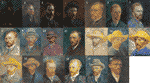
Figure 1 A chronological list of self-portraits painted past van Gogh during his stay in Paris between 1886 and 1888 (Credits: Van Gogh Museum, Amsterdam - Vincent van Gogh Foundation).
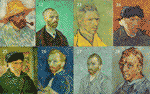
Figure 2 A chronological listing of cocky-portraits painted by Vincent van Gogh during his stay in Arles and at the asylum of St-Remy between 1888 and 1889. The sequence is numbered continuing from the portraits in Effigy 1 (Credits: Van Gogh Museum, Amsterdam - Vincent van Gogh Foundation).
In order to test the fettle of our proposed model to the data, given the result of GABA dysfunction on contrast perception, we aimed to obtain a measure of contrast from these images with an expectation of dissimilarity increases in times of excessive absinthe intake. For each digital epitome, the luminance of a pixel was obtained from its reddish, green, blue (RBG) components as 0.299R + 0.587G + 0.114B (47).
In society to quantify the dissimilarity of the luminance in the portraits, nosotros considered the digital image as a 2-dimensional random process which is fully characterized past its mean and its autocorrelation function. The autocorrelation role describes the relationship (correlation) between two samples of a random process at a sure lag. The autocorrelation function evaluated at its origin is the average normalized power in the random process, e.g. the average contrast across the image (48). The computationally efficient arroyo to the adding of the autocorrelation function of a Northward-dimensional process exploits the Wiener–Khinchin theorem, that states that the autocorrelation function of a broad-sense-stationary random procedure has a spectral decomposition given by the ability spectrum of that process (49). The latter can be quickly calculated for a 2D-process using the 2-D Fourier Fast Transform (FFT) (49); hence the matrix of luminance values was transformed using the 2nd-FFT and the value at the origin produced the required average paradigm contrast. All calculations were performed using Matlab (v. R2018b, The Mathworks Inc., Natick, MA, U.s.).
Average prototype dissimilarity was then tested betwixt 2 conditions, low absinthe consumption and loftier absinthe consumption (portraits ix-x-11-12-21-22-23-27-28) where conditions were defined according to absinthe consumption reported in Table ane of (23). Difference in consumption between the 2 conditions was tested using a Mann-Whitney U exam using SPSS v.25 (IBM Corp).
Results
The results are plotted in Figure three and illustrate an interesting timeline that i could also appreciate through the qualitative assay of the self-portraits in Figures 1 and 2. The average paradigm dissimilarity of the paintings starts at depression levels, close to 0, for the early product in Paris in 1886, every bit this coincides with a fashion that resembles the late xixthursday century standard (xvi). The contrast then steadily increases, reaching the maximum level ~0.v in the showtime months of 1887 (portrait no. 12). We tin can relate the variability of the image contrast with events in the life of van Gogh. The famous painting Café Table with Absinthe, that became the symbol for the consumption of this alcoholic drinkable by the Parisian artistic elite, was in fact painted past van Gogh in Feb-March 1887 (16), in a menstruation that coincided with the showtime serious symptoms of his illness, including episodes of sudden terror, lapses of consciousness, irascibility (15). Soon later on, his consumption of the liquor stopped, only to resume when he arrived in Arles in 1888 (15). It is again unlikely to be a coincidence that the paradigm contrast in the cocky-portraits drops in the 2nd half of 1887 (portraits no. 13-20), but to recover in 1888 (portraits 21-23), which is when his drinking, as well as his use of other substances, restarted and the illness took a stronger hold, ultimately causing him to take delusions and hallucinations that prompted the attack on Gauguin.
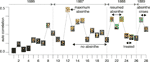
Figure iii The plot shows the average image contrast of the self-portraits; the sequence follows the numbered order of the previous figures.
This theory is further corroborated by the fact that the cocky-portraits numbered 24-25, that have much lower image contrast, show the artist with a cast on his ear lobe, a self-inflicted injury after the assault on Gauguin; these portraits were painted while he was receiving treatment. The terminal bouts of his disease (belatedly 1889 early 1890) before his death were all triggered by absinthe and are accurately documented by (23); there are just two self-portraits (numbered 27-28) for this period of time. Information technology is articulate from the plot in Figure 3 that the contrast for these works increased over again to the very high levels characterizing the previous severe periods of his disease. Considering the entire timeline, the divergence in prototype average contrast betwixt the depression- and high-absinthe consumption states as divers above was statistically significant (p=0.016).
All of the above is consistent with the hypothesis that the changing style of van Gogh'south brushwork was closely associated with substance abuse. In other words, the consumption of thujone analogs that likely impaired his parvalbumin interneuron function possibly acquired the artist to increase the contrasts in his work in society to compensate for problems in lateral inhibition in his visual cortices.
Give-and-take
From his starting time in Paris in 1886, van Gogh's emerging style saw him display an e'er-increasing emotional expression on subjects through his use of patterns and brushwork. He deliberately used colors to capture mood, rather than using them realistically, unlike whatever other artist at the fourth dimension. This is well captured by the words of the creative person himself:"Instead of trying to reproduce exactly what I meet before me, I make more capricious apply of color to express myself more forcefully" (Letter 663 to his brother Theo, Arles Baronial 1888, van Gogh Museum, Amsterdam).
The intensity of artistic experiences has been the subject of recent work in the neurosciences. Vessel, Starr, and Rubin (45) were the starting time to apply fMRI to testify that esthetic feel engages sensory regions, resulting in functional activity in occipito-temporal regions and in increased activity of the striatum, linearly with esthetic ratings of the paintwork. However, their study also reports a stepwise increase in activity in another ready of regions that activated specifically in response to the piece of art that individuals rated as ranking at the top of their appreciation scale. This network mostly contains regions of the DMN (45). This work has since been replicated (45, l) and supports the idea that fine art and in particular brainchild (i.e., separating a depiction from any literal, representational point of reference and merging it with the personal) requires the combined action of sensory cortices and the DMN—2 sets of brain networks typically viewed as functioning in opposition to i some other (50).
As hypothesized, a dysfunction in GABA interneurons is likely to cause problems in the alternating activation and deactivation of the DMN and its adjoining cortices. In the case of van Gogh, nosotros propose that this phenomenon might have facilitated the biological underpinning of the fusion between the esthetic and personal experiences.
In this manuscript we used a multi-scale model of brain function to test the hypothesis that van Gogh'southward illness may take exerted important influences upon his artistic creations. This was achieved past outset analyzing the micro-features of his art in a quantitative analysis by using the average image contrast of his paintings, and secondly by inspecting the macro-features of his piece of work in a qualitative style. However, information technology would be naïve to presume that the unique style of van Gogh tin can exist attributed largely to his illness. The features discussed are non informative with respect to the qualitative value of his creations, nor exercise they advise that impaired role of parvalbumin interneurons could be the crusade of greater artistic achievement. Interestingly though, like quantitative approaches have been used to attempt to sympathize the phenomenon of artistic appreciation. In the merely other application of a quantitative model to van Gogh'due south paintings, Aragon and colleagues (51) demonstrated that luminance fluctuations in a number (merely not all) of the most famous of van Gogh's paintings, for example Starry Night, issue in a statistical distribution that lies close to that of turbulent menses. Turbulence is characterized partly by the existence of energy cascades between the largest and smallest scales. They did this by using the entire shape (and non just the value at the origin every bit reported here) of the autocorrelation function; this function denotes the human relationship between the luminance at increasing distances between the voxels of the paintings and in the example of Starry Night this function was a logarithmic disuse. This is interesting because the same logarithmic decay has been observed in the autocorrelation role of structural brain images and characterizes both the time and space correlation at residue in human being functional action when measured with EEG, Million or fMRI (52). The similarity betwixt the autocorrelation function of the fine art piece and the functional response to information technology by the observer has been indicated as the potential mechanism underlying the appreciation of painters (53) with specific examples such as Jackson Pollock (54) (but run across also (55) for a quantitative comparison between Pollock and van Gogh), as well as of composers, such every bit Bach and Mozart (56–58).
Limitations
The written report presented hither has some limitations. Firstly, this is an historical investigation and the information portion of this work demonstrates an clan between the image contrast of van Gogh's self-portraits and his absinthe consumption; the latter was not direct measured but derived indirectly from reports and, in particular, the detailed written report of Arnold [Table 1 of (23)]. Hence, this is meant equally some other part of the tapestry of data concerning the relationship between the art of van Gogh and his mental illness but ultimately, given the lack of post-mortem reports, this relationship will never be fully elucidated; hopefully though, it will inform future studies in this area.
Secondly, i needs to be aware that Van Gogh'south paintings could have undergone changes in luminescence over time, for example with regard to chemicals used or the interaction with the material used (59). This may take contributed to some of the variation in the data presented in Figure 3. Consider for example the portrait no.xv in Figure 3 [titled "Cocky-portrait with straw hat" (threescore)]. For this work, Van Gogh used cardboard equally a less expensive alternative to canvas and so practical a layer of oil for priming with dashes of purple. The regal pigment in the paint has largely faded over time lessening the contrast with the yellow straw; however, this portrait all the same holds the largest average dissimilarity of the serial in Figure 3.
Finally, we chose as quantitative metric the average image contrast, a simple tool derived directly from our model of interneuron dysfunction with consistent disturbance in lateral inhibition; more sophisticated analytical approaches have been proposed that tin dissect different aspects of van Gogh'southward style (meet for example [61)] although not necessarily related to the biology of his disorder.
Conclusion
In summary, we advise that the timeline of the image contrast across the self-portraits of van Gogh highlights interesting clues as to the potential biological bases of his disorder, and we hope that this work will be of value with respect to the study of the relationship betwixt psychiatric disorders and creative creation.
Data Availability Statement
The datasets generated for this study are bachelor on request to the corresponding author.
Writer Contributions
All authors contributed to the article and approved the submitted version. FT and PD performed the data analysis. All agreed to be accountable for all aspects of the work, its accuracy and integrity.
Funding
FT wishes to acknowledge support from a project grant from the UK Medical Research Council (Ref: MR/K022733/1). EF and RL were funded by the MRC (Ref: MR/R005370/1). The authors would also like to acknowledge back up from the Data to Early Diagnosis and Precision Medicine Industrial Strategy Challenge Fund, UK Research and Innovation (UKRI), the National Found for Health Enquiry (NIHR), the Biomedical Research Centre at South London, the Maudsley NHS Foundation Trust, and King's College London.
Conflict of Interest
The authors declare that the research was conducted in the absence of any commercial or financial relationships that could be construed as a potential disharmonize of interest.
Acknowledgments
FT would like to thank Ms Elisabetta Meda for first drawing attention to the ideas behind this work. We would also similar to thank the two reviewers for the effective criticism and suggestions.
References
ane. Pearce MT, Zaidel DW, Vartanian O, Skov Thou, Leder H, Chatterjee A, et al. Neuroaesthetics: The Cognitive Neuroscience of Aesthetic Experience. Perspect Psychol Sci (2016) 11:265–79. doi: 10.1177/1745691615621274
PubMed Abstract | CrossRef Full Text | Google Scholar
3. Ticini LF, Rachman L, Pelletier J, Dubal S. Enhancing aesthetic appreciation past priming canvases with actions that match the artist'southward painting manner. Front end Hum Neurosci (2014) eight:391. doi: ten.3389/fnhum.2014.00391
PubMed Abstruse | CrossRef Full Text | Google Scholar
4. Wang T, Mo L, Vartanian O, Cant JS, Cupchik Thou. An investigation of the neural substrates of mind wandering induced by viewing traditional Chinese landscape paintings. Front Hum Neurosci (2014) 8:1018. doi: 10.3389/fnhum.2014.01018
PubMed Abstract | CrossRef Total Text | Google Scholar
5. Salimpoor VN, Benovoy M, Larcher Grand, Dagher A, Zatorre RJ. Anatomically distinct dopamine release during anticipation and experience of tiptop emotion to music. Nat Neurosci (2011) 14:257–62. doi: x.1038/nn.2726
PubMed Abstruse | CrossRef Total Text | Google Scholar
half-dozen. Salimpoor VN, van den Bosch I, Kovacevic Due north, McIntosh AR, Dagher A, Zatorre RJ. Interactions between the nucleus accumbens and auditory cortices predict music reward value. Scientific discipline (2013) 340:216–9. doi: ten.1126/science.1231059
PubMed Abstruse | CrossRef Full Text | Google Scholar
viii. Zeki S. Inner Vision: An Exploration of Art and the Brain. Oxford: Oxford Academy Printing (2000).
Google Scholar
nine. Miller GF. Aesthetic fitness: how sexual option shaped creative virtuosity equally a fitness indicator and aesthetic preferences equally mate pick criteria. Bull Psychol Arts (2001) two:20–five. doi: x.1037/e514542010-007
CrossRef Full Text | Google Scholar
11. Zaidel DW. Neuropsychology of art : neurological, cerebral, and evolutionary perspectives. New York: Psychology Printing, Hove England (2005).
Google Scholar
12. Zaidel DW. Neuroscience, biology, and brain evolution in visual art. In: Schellekens EE, Goldie P, editors. The Artful Mind: Phylosophy and Psychology. Oxford: Oxford University Press (2011). p. 44–53.
Google Scholar
13. Turkheimer FE, Leech R, Skilful P, Lord LD, Vernon AC. The brain's code and its approved computational motifs. From sensory cortex to the default mode network: A multi-scale model of encephalon part in health and disease. Neurosci Biobehav Rev (2015) 55:211–22. doi: 10.1016/j.neubiorev.2015.04.014
PubMed Abstruse | CrossRef Full Text | Google Scholar
fourteen. Nakazawa K, Zsiros V, Jiang Z, Nakao K, Kolata Southward, Zhang Southward, et al. GABAergic interneuron origin of schizophrenia pathophysiology. Neuropharmacology (2012) 62:1574–83. doi: 10.1016/j.neuropharm.2011.01.022
PubMed Abstruse | CrossRef Full Text | Google Scholar
16. Van Gogh Museum Amsterdam, Tilborgh Fifty.V., Vellekoop M. Vincent van Gogh paintings, Van Gogh Museum. Distributed in the USA past Antique Collectors' Lodge, Amsterdam London Wappingers Falls, N.Y.: Lund Humphries Publishers (1999).
Google Scholar
17. Strang J, Arnold WN, Peters T. Absinthe: what's your poison? Though absinthe is intriguing, it is booze in general nosotros should worry near. BMJ (1999) 319:1590–ii. doi: 10.1136/bmj.319.7225.1590
PubMed Abstract | CrossRef Total Text | Google Scholar
nineteen. Granger RE, Campbell EL, Johnston GA. (+)- And (-)-borneol: efficacious positive modulators of GABA activity at human recombinant alpha1beta2gamma2L GABA(A) receptors. Biochem Pharmacol (2005) 69:1101–11. doi: 10.1016/j.bcp.2005.01.002
PubMed Abstruse | CrossRef Full Text | Google Scholar
20. Hall Air conditioning, Turcotte CM, Betts BA, Yeung WY, Agyeman Equally, Burk LA. Modulation of human being GABAA and glycine receptor currents past menthol and related monoterpenoids. Eur J Pharmacol (2004) 506:9–16. doi: ten.1016/j.ejphar.2004.10.026
PubMed Abstract | CrossRef Full Text | Google Scholar
21. Yang H, Woo J, Pae AN, Um MY, Cho NC, Park KD, et al. Alpha-Pinene, a Major Constituent of Pine Tree Oils, Enhances Non-Rapid Eye Movement Sleep in Mice through GABAA-benzodiazepine Receptors. Mol Pharmacol (2016) 90:530–9. doi: 10.1124/mol.116.105080
PubMed Abstract | CrossRef Total Text | Google Scholar
22. Czyzewska MM, Mozrzymas JW. Monoterpene alpha-thujone exerts a differential inhibitory activity on GABA(A) receptors implicated in phasic and tonic GABAergic inhibition. Eur J Pharmacol (2013) 702:38–43. doi: 10.1016/j.ejphar.2013.01.032
PubMed Abstruse | CrossRef Total Text | Google Scholar
24. Cooper Y, Agius Chiliad. Does Schizoaffective Disorder explain the mental illnesses of Robert Schumann and Vincent Van Gogh? Psychiatr Danub (2018) thirty:559–62
PubMed Abstract | Google Scholar
25. Deutsch D. The fabric of reality : the science of parallel universes– and its implications. New York: Allen Lane (1997).
Google Scholar
27. Borgers C, Kopell Due north. Synchronization in networks of excitatory and inhibitory neurons with thin, random connectivity. Neural Comput (2003) xv:509–38. doi: 10.1162/089976603321192059
PubMed Abstruse | CrossRef Full Text | Google Scholar
28. Helmstaedter Thou, Sakmann B, Feldmeyer D. Neuronal correlates of local, lateral, and translaminar inhibition with reference to cortical columns. Cereb Cortex (2009) 19:926–37. doi: 10.1093/cercor/bhn141
PubMed Abstract | CrossRef Total Text | Google Scholar
29. Fox Physician, Snyder AZ, Vincent JL, Corbetta M, Van Essen DC, Raichle ME. The man brain is intrinsically organized into dynamic, anticorrelated functional networks. Proc Natl Acad Sci U S A (2005) 102:9673–8. doi: 10.1073/pnas.0504136102
PubMed Abstruse | CrossRef Total Text | Google Scholar
30. Jang JH, Jung WH, Kang DH, Byun MS, Kwon SJ, Choi CH, et al. Increased default mode network connectivity associated with meditation. Neurosci Lett (2011) 487:358–62. doi: 10.1016/j.neulet.2010.10.056
PubMed Abstract | CrossRef Full Text | Google Scholar
31. Kim D, Zemon V, Saperstein A, Butler PD, Javitt DC. Dysfunction of early-stage visual processing in schizophrenia: harmonic assay. Schizophr Res (2005) 76:55–65. doi: ten.1016/j.schres.2004.10.011
PubMed Abstract | CrossRef Full Text | Google Scholar
32. Nguyen Advert, Shenton ME, Levitt JJ. Olfactory dysfunction in schizophrenia: a review of neuroanatomy and psychophysiological measurements. Harv Rev Psychiatry (2010) xviii:279–92. doi: 10.3109/10673229.2010.511060
PubMed Abstruse | CrossRef Full Text | Google Scholar
34. Hyman J. Fine art and Neuroscience. In: Frigg R, Hunter G, editors. Beyond Mimesis and Convention. Boston: Springer (2010). p. 245–61.
Google Scholar
35. Stephan KE, Friston KJ, Frith CD. Dysconnection in schizophrenia: from abnormal synaptic plasticity to failures of self-monitoring. Schizophr Bull (2009) 35:509–27. doi: 10.1093/schbul/sbn176
PubMed Abstruse | CrossRef Full Text | Google Scholar
36. Benes FM, Berretta South. GABAergic interneurons: implications for understanding schizophrenia and bipolar disorder. Neuropsychopharmacology (2001) 25:ane–27. doi: 10.1016/S0893-133X(01)00225-1
PubMed Abstruse | CrossRef Full Text | Google Scholar
37. Kaar SJ, Angelescu I, Marques TR, Howes OD. Pre-frontal parvalbumin interneurons in schizophrenia: a meta-analysis of postal service-mortem studies. J Neural Transm (Vienna) (2019) 126:1637–51. doi: 10.1007/s00702-019-02080-2
PubMed Abstract | CrossRef Total Text | Google Scholar
40. Modinos G, Simsek F, Azis M, Bossong M, Bonoldi I, Samson C, et al. Prefrontal GABA levels, hippocampal resting perfusion and the gamble of psychosis. Neuropsychopharmacology (2018) 43:2652–9. doi: 10.1038/s41386-017-0004-vi
PubMed Abstract | CrossRef Full Text | Google Scholar
41. Cotton wool SA. Vincent van Gogh, chemistry and absinthe. Educ Chem (2011) 48:75–nine.
Google Scholar
42. Muller WE, Snyder SH. delta-Aminolevulinic acid: influences on synaptic GABA receptor bounden may explain CNS symptoms of porphyria. Ann Neurol (1977) 2:340–two. doi: 10.1002/ana.410020415
PubMed Abstruse | CrossRef Full Text | Google Scholar
43. Taghipour M, Derakhshan North, Saffarian A. At Eternity's Gate: Temporal Lobe Epilepsy and the Genius of Vincent van Gogh. Psychiatr Danub (2019) 31:374–six. doi: 10.24869/psyd.2019.374
PubMed Abstract | CrossRef Full Text | Google Scholar
45. Vessel EA, Isik AI, Belfi AM, Stahl JL, Starr GG. The default-mode network represents aesthetic entreatment that generalizes across visual domains. Proc Natl Acad Sci U Southward A (2019) 116:19155–64. doi: 10.1073/pnas.1902650116
PubMed Abstract | CrossRef Full Text | Google Scholar
46. Williams PG, Johnson KT, Curtis BJ, King JB, Anderson JS. Individual differences in aesthetic date are reflected in resting-state fMRI connectivity: Implications for stress resilience. Neuroimage (2018) 179:156–65. doi: 10.1016/j.neuroimage.2018.06.042
PubMed Abstract | CrossRef Full Text | Google Scholar
47. Gonzalez RC, Forest RE, Eddins SL. Digital image processing using MATLAB. Knoxville: Gatesmark Publishing (2020).
Google Scholar
48. Miller SL, Childers D. Random processes, Probability and Random Processes Amsterdam: Elsevier (2012) p. 335–82.
Google Scholar
49. Chatfield C. The Analysis of Time Serial—An Introduction. London: Chapman and Hall (1989).
Google Scholar
50. De Pisapia N, Bacci F, Parrott D, Melcher D. Encephalon networks for visual creativity: a functional connectivity study of planning a visual artwork. Sci Rep (2016) 6:39185. doi: x.1038/srep39185
PubMed Abstruse | CrossRef Total Text | Google Scholar
51. Aragon JL, Naumis GG, Bai K, Torres 1000, Maini PK. Turbulent Luminance in Impassioned van Gogh Paintings. J Math Imaging Vis (2008) 30:275–83. doi: 10.1007/s10851-007-0055-0
CrossRef Total Text | Google Scholar
52. Expert P, Lambiotte R, Chialvo DR, Christensen G, Jensen HJ, Sharp DJ, et al. Self-similar correlation role in brain resting-state functional magnetic resonance imaging. J R Soc Interface (2011) 8:472–9. doi: x.1098/rsif.2010.0416
PubMed Abstract | CrossRef Full Text | Google Scholar
53. Bhattacharya J, Petsche H. Shadows of artistry: cortical synchrony during perception and imagery of visual art. Encephalon Res Cognit Encephalon Res (2002) thirteen:179–86. doi: 10.1016/S0926-6410(01)00110-0
CrossRef Full Text | Google Scholar
54. Taylor RP, Spehar B, Van Donkelaar P, Hagerhall CM. Perceptual and Physiological Responses to Jackson Pollock'southward Fractals. Front end Hum Neurosci (2011) 5:60. doi: x.3389/fnhum.2011.00060
PubMed Abstract | CrossRef Full Text | Google Scholar
55. Shamir L. Figurer analysis reveals similarities between the artictic styles of van Gogh and Pollock. Leonardo (2012) 45:149–54. doi: 10.1162/LEON_a_00281
CrossRef Full Text | Google Scholar
57. Teixeira Borges AF, Irrmischer 1000, Brockmeier T, Smit DJA, Mansvelder HD, Linkenkaer-Hansen Grand. Scaling behaviour in music and cortical dynamics interplay to mediate music listening pleasure. Sci Rep (2019) 9:17700. doi: x.1038/s41598-019-54060-10
PubMed Abstract | CrossRef Total Text | Google Scholar
59. Centano SA, Hale C, Carò F, Cesaratto A, Shibayama N, Delaney J, et al. Van Gogh'south Irises and Roses: the contribution of chemic analyses and imaging to the assessment of color changes in the carmine lake pigments. Heritage Sci (2017) 5. doi: x.1186/s40494-017-0131-8
CrossRef Total Text | Google Scholar
61. Berezhnoy I, Postma Eastward, van den Herik J. Estimator analysis of Van Gogh's complementary colours. Blueprint Recogn Lett (2006) 28:703–three. doi: 10.1016/j.patrec.2006.08.002
CrossRef Full Text | Google Scholar
hardestyopeance73.blogspot.com
Source: https://www.frontiersin.org/articles/10.3389/fpsyt.2020.00685/full
0 Response to "Art Appreciation Chapter 11 Vincent Van Gogh the Bedroom"
Post a Comment