How Many Regulations Pulled Back Under Congresional Review Act
EXECUTIVE SUMMARY
- It at present appears that whatsoever federal rulemaking published on or afterwards May thirteen could be subject to rescission under the Congressional Review Act (CRA), although volatility will remain for predicting the exact date.
- Potential targets nether the CRA falling after May 13 could include deregulatory actions with an estimated combined savings of $11.vii billion too as several deportment instituting hotly debated social and legal policies.
- Outside of some unforeseen issue that requires Congress to officially convene more than than expected, whatever terminal dominion published from now through the finish of the year likely could exist subject to CRA scrutiny in 2021.
INTRODUCTION
As noted 2 months ago, 1 under-appreciated policy implication of the COVID-nineteen pandemic is how information technology volition affect the accomplish of the Congressional Review Act (CRA), i of Congress'due south nigh powerful instruments for addressing the authoritative state. With the House of Representatives fix to return (to the extent that it tin can given the threat of the virus) for its nearly substantive legislative menses in several weeks, it is worth reexamining where the potential CRA situation stands. Evolving circumstances accept caused – and perhaps could cause going forward – some variance in the likely CRA "window," but that overall movie is becoming more well-defined. While some of the most notable Trump Administration rules now appear safe from the Act's grasp, it is at present clear that (barring some truly extraordinary change in Congress's schedule) there are a handful of significant rules from the bound that remain likely targets, and every Trump Assistants rule from hither on out is probable vulnerable.
THE Basic DYNAMICS OF THE CRA
From the kickoff, information technology is of import to note that this discussion is largely only relevant if the Democrats concord the presidency and majorities in both chambers of Congress come 2021, as the Republicans did in 2017. The CRA allows Congress to pass joint resolutions of disapproval that vacate a regulation in its entirety. Since these resolutions are still bailiwick to a presidential veto, however, their passage is historically uncommon since a sitting president is not exactly keen to eliminate his own assistants's actions.
Thanks to the CRA's "look-dorsum" menstruum, though, there is a scenario following a presidential transition that makes action in the CRA realm more plausible. The look-dorsum provision essentially dictates that any rule published inside 60 session days of a Congress adjourning sine die then gets rolled over to the following Congress. In 2017, the Republican majorities in Congress and President Trump passed an unprecedented amount of CRA resolutions into law, thereby rescinding a whole series of significant Obama-era regulations. If there is a President Biden and Democratic majorities in both chambers, a similar dynamic could ensue.
Another important aspect of the CRA is the process that it, at least temporarily, establishes in the Senate. Starting on the xvth session day of the newly convened Senate and going out 60 session days from then, a CRA resolution bypasses the normal cloture process that requires a sixty-vote threshold and tin can pass by a simple majority. Therefore, fifty-fifty the slimmest of Democratic majorities could vote through such resolutions. For case, the efforts to overturn the tranche of Obama-era rules in 2017 included Senate votes that involved Vice President Pence breaking a fifty-fifty tie.
NOTABLE SHIFTS IN Contempo MONTHS
The April review of how the shifting circumstances under COVID-nineteen could affect a potential CRA look-back window indicated that May 20 would exist the cut-off date; rules published on or after that date could be discipline to the CRA next year. Given the various disruptions to Congress's ability to operate nether COVID-nineteen, this project was subject to a loftier degree of possible variance based upon shifting assumptions. It turns out that that variance presented itself in the intervening months.
At the stop of May, House Majority Leader Steny Hoyer released an updated projected Business firm schedule in light of Congress'due south limited ability to safely and fully convene due to COVID-19. The most important departure in that updated calendar was that the House was expected to convene only for ane twenty-four hours in the calendar month of June. The previous calendar had sixteen session days in the month of June. This 15 session-day difference thereby pushed the CRA cutting-off date to April 17. The nigh meaning implication of this shift was that two of the Trump Administration'southward most consequential deregulatory deportment – "The Safer Affordable Fuel-Efficient (Condom) Vehicles Rule" and its update of the "Definition of 'Waters of the United States' (WOTUS)" – were now vulnerable under the CRA.
And then June actually happened. As it turns out, the House ended upwards technically convening for 7 days so far in the month, albeit largely on a perfunctory basis to permit for the consideration of various minor matters. Regardless of their significance, however, these days apply to the CRA countdown. Additionally, as the following agenda indicates, that chamber'due south render was bumped upwardly by three days.
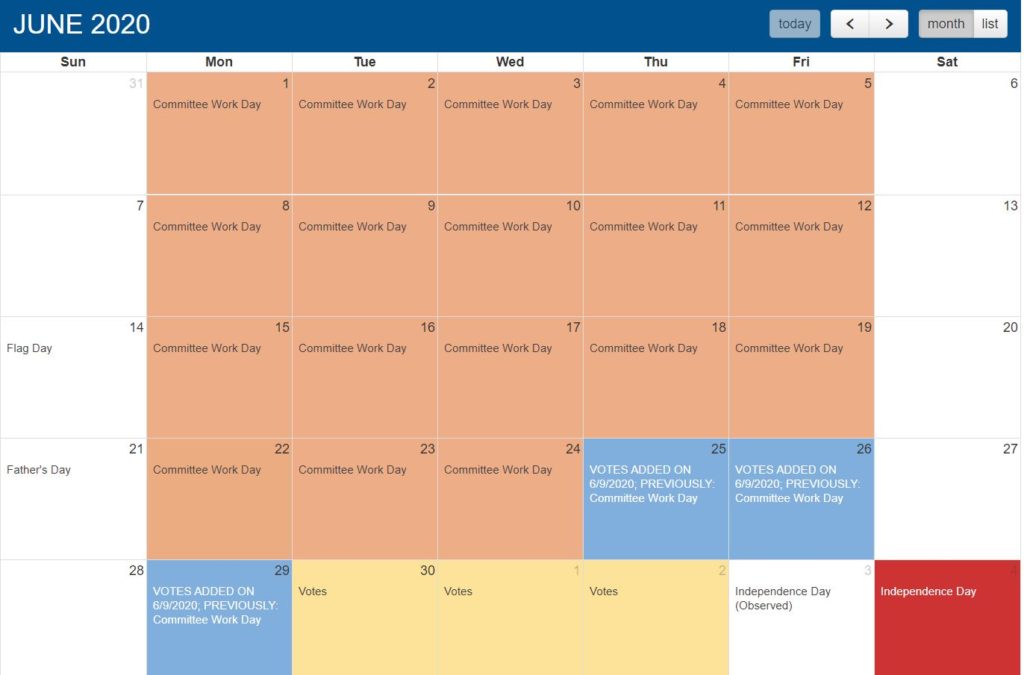
As a result, instead of only having 1 session day in June, the House will have had xi. This x-day swing necessarily pushes the CRA cut-off subsequently into calendar yr 2020. Under these changes, and assuming the Firm follows this updated calendar going frontward, May thirteen is the new lx-day cut-off point. This appointment is slightly earlier than the April project, merely non early enough to endanger either the Condom rule or the WOTUS redefinition.
WHAT THE Current PROJECTED "WINDOW" MEANS
Even though those two major rules are at present seemingly exterior of the CRA window, there are a handful of notable rules that likely remain liable to CRA action in 2021. Equally part of its ongoing RegRodeo project, the American Action Forum tracks all federal rulemakings that have some quantified economic impact guess. Many of the Trump Administration's deregulatory actions have drawn some level of criticism from Democratic lawmakers. Equally such, one would expect that those actions would be among the commencement that a Autonomous majority would target. The post-obit table includes the top five deregulatory actions, in terms of quantified net present value savings, published from May xiii through final week.
| Rule | Savings ($ Billions) |
| Default Electronic Disclosure by Employee Pension Benefit Plans Under ERISA | 4.6 |
| Nondiscrimination in Wellness and Health Education Programs or Activities, Delegation of Say-so | 3.iv |
| Hours of Service of Drivers | 3.1 |
| Person in Charge of Fuel Transfers | 0.4 |
| Patient Protection and Affordable Care Human action; HHS Discover of Benefit and Payment Parameters for 2021; Notice Requirement for Non-Federal Governmental Plans | 0.2 |
| Total | 11.seven |
There may exist varying levels of enthusiasm, however, toward fifty-fifty this set of rules. For instance, the Default Electronic Disclosure rule makes the relatively mundane shift from programme disclosures via paper to electronic versions. Contrast that with the Nondiscrimination rule that touches upon contentious social and legal bug.
There are also at to the lowest degree some rules that, while they are net-regulatory in economic terms, establish certain policies Democrats largely disagree with. A couple have already received explicit criticism from Autonomous lawmakers and officials. Notable examples here include a recent update to Community Reinvestment Act regulations and the Trump Administration's changes to standards regarding sexual harassment adjudication on college campuses.
Additionally, it is relatively safe to assume that whatever of the concluding rules published going frontward in 2020 would be bailiwick to the CRA. There accept been 15 session days between the currently estimated May 13 cut-off and at present. For rules published now to be safe from CRA review, a scenario would have to unfold that involved the Firm meeting for at to the lowest degree sixteen more days than currently expected. For reference, at that place are merely 45 more planned days on the House calendar; such a relatively large span getting added on top of that is possible but would also exist quite boggling. Furthermore, that number would take to continue to grow in order to push the cut-off fifty-fifty later.
Determination
There is proficient reason why the CRA is oftentimes described every bit "little known" or "rarely utilized." It focuses on a very mundane policy area, authoritative rulemaking, and requires a unique political residual to always be effective. Equally Congress works on other business organization, notwithstanding, it could affect the CRA's relevance next yr. Even shifts in when Congress technically "meets" could take meaning implications for Trump-era regulatory deportment, with billions of dollars in economic impact hanging in the rest.
hardestyopeance73.blogspot.com
Source: https://www.americanactionforum.org/insight/an-update-on-the-congressional-review-act-in-2020/
0 Response to "How Many Regulations Pulled Back Under Congresional Review Act"
Post a Comment